

Online Strategies
What is a Lead Magnet. Examples and meaning

(Desarrollador FullStack)
Let me put you in our context.
We work with Gatsby as a framework and we rely on the following platforms:
All these platforms have an initial cost of 0€, so it's great — you can be there during the entire development without incurring infrastructure costs.
And once the project is launched, as long as you consume the minimum it will still be free.
Prices extracted as of 10-12-2021 from their website.
Netlify has many more functions and extras, but these are the ones that matter most.
If Netlify makes you scratch your pocket, it means that things are working well on your project.
If not, some business strategy is wrong.
As you can see, these limits allow a lot of flexibility. Even if you go over, it's not dramatic — the only one that falls a bit short is Forms, since sending an email to a user is a common action. It’s also surprising that this quota is so low compared to the rest.
The reason is that the difficulty of implementing them is minimal.
It's as simple as inserting the property data-netlify="true" in an HTML <form>, and it just works. Once submitted, it arrives at Netlify, where with just a click you can configure what to do with it:
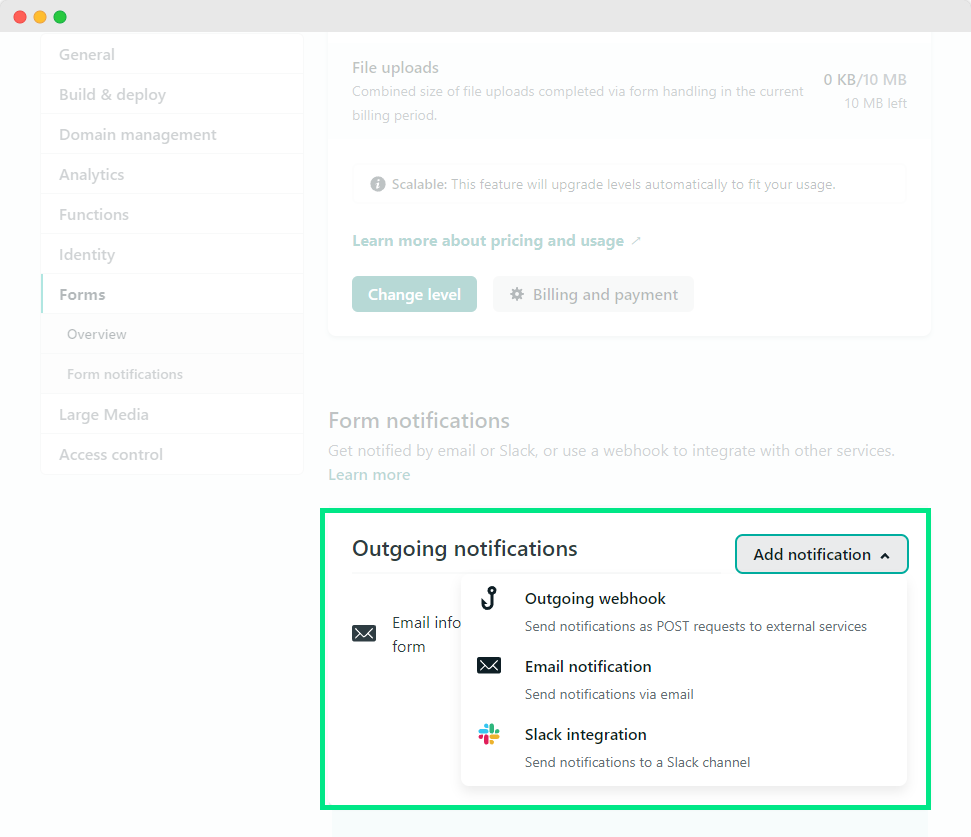
But of course, if you are spending every month you might think it's a significant amount — about 16.85€ at the monthly exchange rate, which is more than 200€ per year. For that price you could find alternatives that might last you a lifetime.
Keep Calm
The fun part of all this is that we are free to change infrastructure.
You can continue using Netlify perfectly and, for example, send emails through Amazon AWS.
You may think: “Then I’ll just use AWS from the start and that’s it.”
But beware: this also has to be implemented, and for those things you end up paying too. Still, it’s worth studying.
We start from the premise of keeping it simple and economical.
If we see that a project doesn’t even require 100 forms, then we are going... nowhere.
We stay on Netlify.
But we don’t use their implementation of Forms.
Thanks to Serverless functions, we can do a bit of whatever we want — including sending forms.
After all, we have at our disposal a Node server in case we need it, with:
Sending an email takes about 1 second or less, so theoretically you could send around 360,000 emails.
But since requests are capped, we leave it at 125,000 emails free (yes, one hundred and twenty-five thousand).
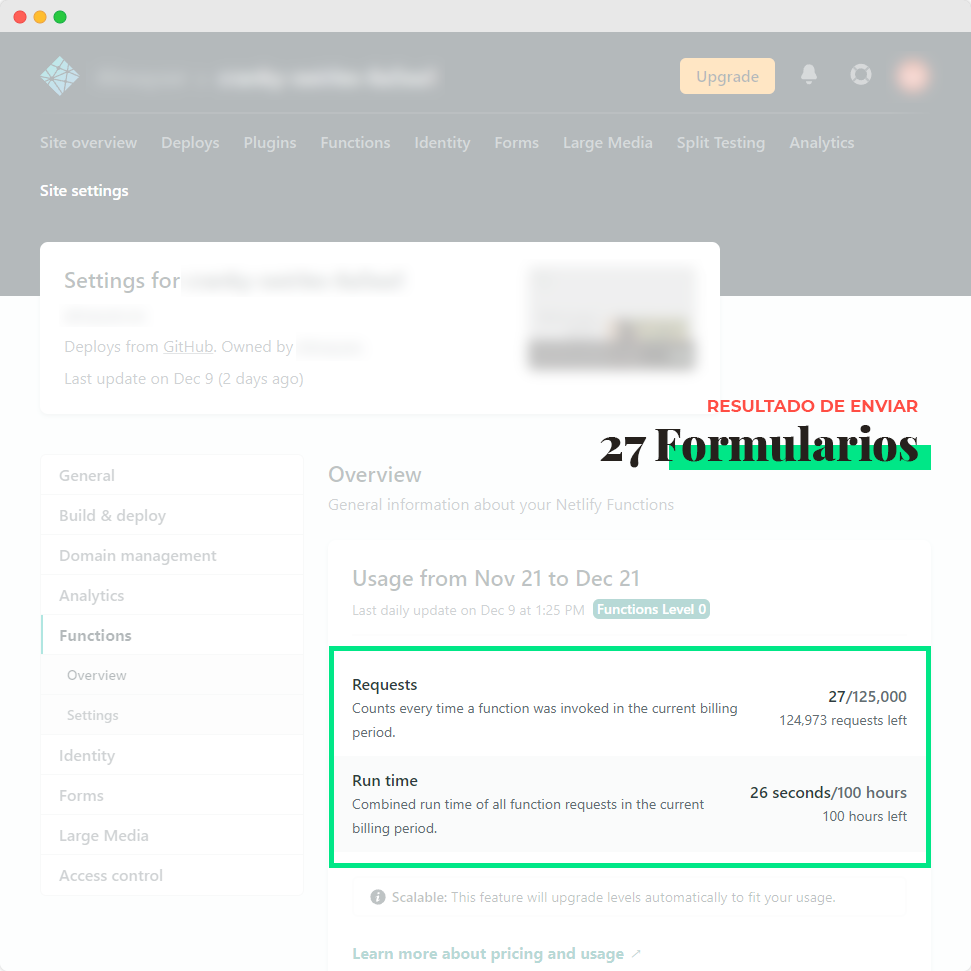
So, once the free limits are crossed and assuming we no longer need to consume functions, the price of sending an email is:
What I like most about implementing technologies like this is that you start from the bottom up, and by distributing the use cases/problems/features you can focus on just one and look for the solution without compromising the rest of the project.
If they charge you a lot for your phone, you don’t have to change the boiler.
In the end I focused on a specific point; for the next one I’ll dive into the rest, otherwise this would be too long.
As you can see, implementation details can make something cost a lot, a little, or almost nothing.
But if you don’t want to worry about these details, we’ve got you covered.
(Desarrollador FullStack)
También te puede gustar
Online Strategies
What is a Lead Magnet. Examples and meaning

Online Strategies
Examples of successful landing pages

000 THECOOKIES Terminal v1.0
Type your email to start a conversation with our AI assistant.
────────────────────────────────────────────────────────